Introduction
In an age of increasingly sophisticated translation apps, why do we still need a real language teacher?
The answer may lie in moments algorithms cannot capture—when a foreign student finally understands that “shanghuo” means more than its literal translation, when “sajiao” ceases to be a stiff dictionary definition, when the delicate cultural veil behind language is gently lifted by a patient hand.
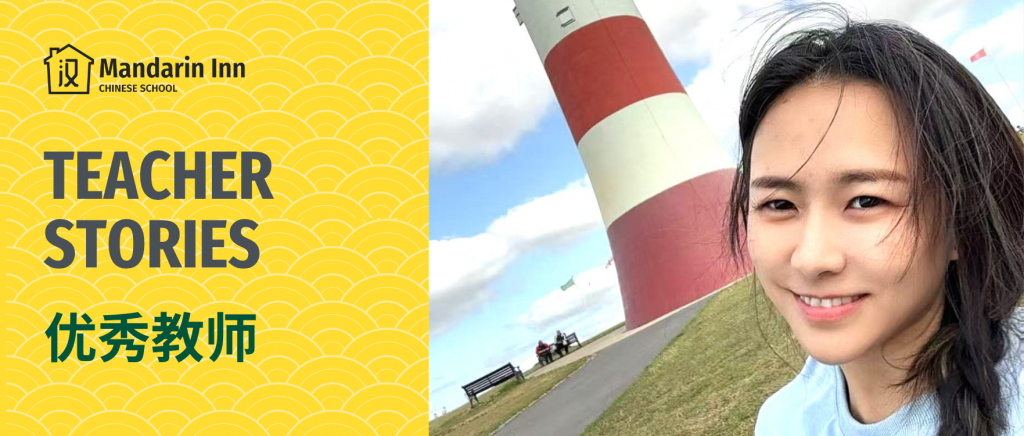
In a century-old heritage villa in Shanghai, we met such a teacher. A graduate of East China Normal University with a degree in English, she honed her skills in the corporate world before stepping into the Chinese classroom. Today, she tells every student, in her own way: learning a language has never been just about vocabulary and grammar.

Self Introduction
“I graduated from East China Normal University with a major in English. Before becoming a Chinese teacher, I worked in a foreign company.”
She says it plainly, but these two experiences form the unique foundation of her classroom today. Her English proficiency allows her to grasp precisely where foreign students struggle, while her corporate background makes real-world business Chinese scenarios second nature to her.
“That experience made me very familiar with communicating with expats and understanding their way of thinking. It also gave me a wealth of workplace scenarios, which has been enormously helpful in my business Chinese teaching.”

First Teaching Experience
She still vividly remembers her first time standing at the podium.
“My first student was a working professional with business communication needs. At first, I was worried there would be language barriers, but with my English foundation and corporate experience, we quickly bridged the distance.”
That lesson taught her something important: most foreigners learning Chinese come with real, practical needs. The classroom content cannot float in the abstract—it must land firmly in their actual lives and work.
Learning Chinese Effectively
When asked for tips on learning Chinese, her answer is unexpectedly off-script.
“I’ve always believed that learning a language isn’t just about words and grammar. More importantly, it’s about understanding the culture the language carries.”
She advises students not to memorize isolated bits of knowledge, but to understand Chinese expressions within cultural contexts. When encountering difficult words, she has one specific request: don’t try to force a direct translation into your native language.
“I tell students not to translate language in a word-for-word way, but to understand the culture behind it. Words like ‘shanghuo’ or ‘sajiao’—it’s really hard to find exact English equivalents.”
This teaching philosophy feels especially precious in an era dominated by translation apps. Algorithms can convert words, but they cannot transmit a cultural lens.

Life Beyond Teaching
Outside the classroom, she is someone who loves to travel.
“I love traveling, experiencing different cultures and landscapes around the world. Being exposed to diverse cultures through travel has made me more sensitive to cultural differences, and it’s easier for me to see things from my students’ perspectives.”
Sometimes, when she mentions her travel experiences in a student’s home country, the distance between them shrinks in an instant.
“When my own experiences happen to overlap with a student’s world, we connect instantly, and I earn their trust. The world is big—you really should go and see it.”
Teaching at Mandarin Inn
Her tone relaxes when she talks about the atmosphere here.
“What I love most about Mandarin Inn is the relaxed, open teaching atmosphere. Every teacher’s ideas are respected, we’re free to explore teaching methods that suit our students, and colleagues are always happy to share their experiences.”
As for suggestions, she offers a simple one: organize more cultural exchange events where students can practice speaking outside the classroom, and where teachers can exchange teaching techniques.
When it comes to the future of teaching Chinese as a foreign language, she doesn’t talk in empty trends.
“As exchanges between China and the world continue to deepen, this field has broad prospects. More and more foreigners want to learn Chinese and understand China.”
But her most precious reward is not career prestige.
“I love this profession. The most precious thing is that through teaching Chinese, I can show the world real Chinese culture. This has always made me happy, and deeply proud.”
Teaching Philosophy
At the end of our conversation, I asked her to summarize her teaching philosophy.
“I believe teaching must be flexible and tailored to each student. It’s not enough to just teach language points—you need rich cross-cultural knowledge as a foundation. Only then can you guide students to understand contextual differences, so they can use Chinese appropriately and gracefully in work and life.”
Outside the window, dappled shadows played across the old villa’s walls. She spoke with a quiet conviction, as if delivering a sentence she had rehearsed for a long time—now ready to be spoken with ease.
Closing
Learning a language is ultimately learning to see the world from another perspective. And a good teacher is the one who leads you through that door.
If you, too, are passionate about language and culture,
dream of becoming an international Chinese teacher,
or are preparing for the Certificate for Teachers of Chinese to Speakers of Other Languages (CTCSOL) —
we warmly invite you to join us at Mandarin Inn and begin your own journey in Chinese education.

Want to become an international Chinese teacher?
Join Mandarin Inn’s CTCSOL Certificate Training Course.
From teaching methodology to cross-cultural communication,
we’ll guide you step by step to become a professional Chinese teacher.
For more details, please click the link below to book or inquire about a free trial session.