

Introduction
The hardest part of learning a language isn’t starting from zero. It’s choosing to push forward after things feel “good enough.”
Many foreigners in China reach a language comfort zone—daily needs are met, taxis are hailed, meals are ordered. But progress stalls. Some accept it. Some leave. And some, quietly, begin again.

In a century-old garden house in Shanghai, we met Rohit. A British educator of Indian heritage who has lived in Chengdu and Shanghai for nearly twelve years. His Chinese hovered around HSK3 for a long time. Last year, he decided to return to the classroom—not for a test, not for a job, but for a simple reason: after all this time, he owed himself a real breakthrough.
Why China?
“I first moved to China on 28th August 2014, so soon it will be my 12-year ‘Chinanniversary,'” Rohit says with a smile.
He is British, of Indian background. A decade after graduating, his career was going nowhere. Friends teaching English abroad seemed to be having a wonderful time. “I would see their posts on Facebook and feel jealous. I wanted to live the life that they were living.”
So he got qualified and applied for jobs all over the world. Two offers came: Chengdu and Mexico. “The job in Chengdu was paying much better. Also, at the time, my parents were in Wuhan, with my dad working as an engineer here. So I thought it made sense to live in the country where I have family in case of emergencies.”
“What was supposed to be one year blossomed into a decade. I live a good life here, and I am very grateful for all that China has given me.”
Like many foreigners in China, Rohit’s Chinese learning hit a long pause.
“I did a serious period of study from 2019 to 2022 at another school. I established a solid foundation. However, like many foreigners, I ended up ‘plateauing.’ I got to a stage where I could take care of all my basic needs and then lost motivation. So my level is currently HSK3.”
Last year he rediscovered his motivation and started classes with Mandarin Inn. “I hope this time I can keep my motivation!!”
Is It Useful to Learn Chinese?
When asked if learning Mandarin is useful for foreigners, Rohit doesn’t hesitate.
“Yes, absolutely. Even in an international city like Shanghai, service providers such as taxi drivers and shopkeepers speak zero English. So at least having a foundation in Mandarin makes your life so much more convenient.”
He shares a recent moment of pride.
“Recently I applied for an ICBC credit card. My financial advisor told me to take a Chinese person with me to the bank for translation help. I decided I was going to deal with it myself. I was able to communicate with the banking staff 99% of the time. It was such an amazing feeling—being able to do something as complicated as a credit card application fully in Chinese.”
“Aside from this reason, I think it is also good manners to try and learn the language of the country where you are living.”

Learning Hacks
On learning methods, Rohit has his convictions.
“While I know some people who have learned Mandarin without learning the characters, I think doing it this way really limits your learning. So definitely learn the characters. Also, anybody who tells you that tones don’t matter is wrong. Definitely establish good pronunciation of the tones, or Chinese people will not understand you.”
His practice is refreshingly simple: his teacher sends notes of their class dialogue, and he reads them aloud, over and over, until the next lesson.
“Another thing I do is try to communicate with a Chinese person on WeChat all in Chinese. I have a few Chinese friends with whom I do this. WeChat has excellent voice-to-text recognition, so if you don’t understand some new words in a voice message, you can get it converted to text and understand what they are saying.”

About the Teacher
Speaking of his Mandarin Inn teacher, Chen Laoshi, Rohit’s tone becomes more animated.
“I really like that Chen Laoshi brings her unique personality to the class. She also brings humor to the classes, which I never had with previous teachers. It shows that learning Chinese doesn’t just have to be serious.”
“I also really like the fact that she is a free thinker who will express opinions that go against the crowd. Free thinkers are always people I want to be around.”
Pedagogically, Chen Laoshi’s approach has made a real difference.
“Chen Laoshi tailors the vocabulary so that we can talk continuously in Chinese for the whole lesson. With previous teachers, they would overload me with so much new vocabulary that we would end up speaking in English. She also encourages me to talk about topics that are of interest to me and helps me to express those ideas in Chinese. This really gives me strong encouragement to learn Mandarin.”
Learning in China
Rohit rarely misses a class. When asked why, his answer is candid.
“I seldom ask for leave because I really am determined to push my Chinese to the next level. I kind of feel bad that after 10 years of being here my Chinese is at a middle level, so this motivates me a lot.”
“I will be honest that I haven’t used the online resources because the notes from the conversation with my teacher are so in-depth that I spend a lot of time learning the new vocabulary.”
In daily life, Rohit still encounters his linguistic soft spots.
“Perhaps a workshop on dealing with delivery drivers would be good. Sometimes I find they say a lot of vocabulary that I am not familiar with.”
He also has a small suggestion about textbooks: “One issue I have is with the HSK book. The dialogues have pinyin included. However, the exercises do not. So if there is a character that I don’t recognize, I have to take a photo of it, then extract it with WeChat to identify the pronunciation and meaning of the character. I feel this takes up a lot of time, so it would be good if pinyin could be included for all sections.”
Workshops
Outside of work, Rohit’s life is surprisingly rich.

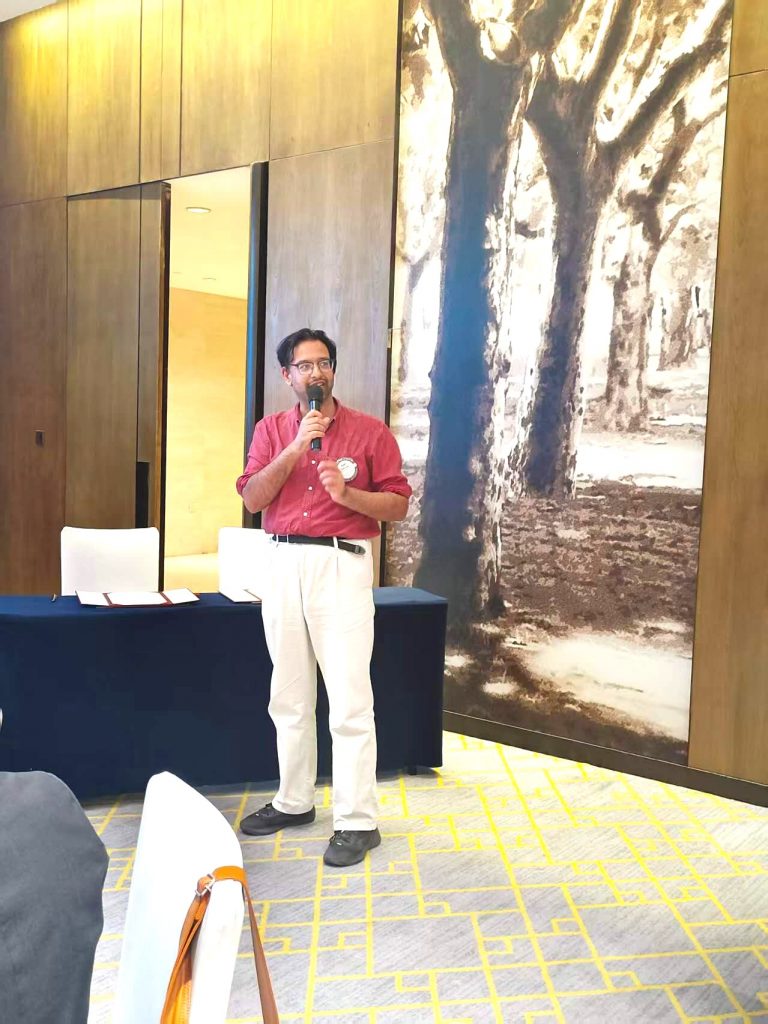
His biggest hobby is volunteering. As a Rotary Club member, he established a workshop program teaching parents how to speak to their children in a kind way, and set up youth Rotary clubs in two Shanghai schools. He also organized free English classes for children from migrant families—in a park, and in a zoo. “I really like to make a positive difference to the world.”
“I really like to make a positive difference to the world.”
He also loves hiking. His proudest achievement: a solo ascent of Rajad Fort in Pune, India—1376 meters above sea level. “My dream is to one day hike in Zhangjiajie. It is still on my bucket list of places to see in China.”
He also enjoys public speaking and has given many talks on fostering a growth mindset in young people. “I hope to be able to give this talk in Chinese!” He also has a tradition: giving a Mandarin goodbye speech to his students on the last day of class. One student uploaded it on Douyin.
Favourite Chinese Sentence
At the end, we asked Rohit for his favorite Chinese phrase.
He said: “Out with the old, in with the new.“
“I am very passionate about personal growth, so this sentence really captures what I believe: we need to get rid of our old thinking and old ways if we want to embrace the new and grow as people.”
This phrase, perhaps, is the best annotation of his twelve-year “Chinanniversary.” In an era where everyone chases the new, he chose to pause and tend to old, unfinished business. Not for anyone else—just for himself.
Closing
Inside the old garden house of Mandarin Inn, language learning has never been just about vocabulary and grammar.
It’s about building a life, piece by piece, in a foreign country. About choosing to push forward long after things feel “good enough.” About facing your own plateau honestly—and quietly crossing it.
Rohit’s story has no dramatic turn, no overnight epiphany. It’s more like a slow, steady river, finding its way around the rocks. And that, perhaps, is the truest portrait of most learners. (End)
Join Mandarin Inn Chinese Courses and Cultural Workshops. From structured learning to real-life practice, we help you make Mandarin part of your everyday life.
Free trial is also available, click the link below to register!

Mandarin Inn, More Than Just a Language School
Located in the scenic heart of Shanghai’s former French Concession, Mandarin Inn is housed in a historic villa, offering not only an ideal place for studying Mandarin but also a chance to experience Shanghai’s rich history and culture. As the home of the APM Public Library and recognized by Ecovadis for corporate social responsibility, Mandarin Inn carries a dual mission of education and cultural heritage.