

Introduction
When someone moves to another country, language is often the first wall they encounter.
But a wall can also become a door.
Rebekka comes from Germany, works as a social worker and diversity trainer, and moved to Shanghai a little over a year ago.
She was once full of doubt about coming to China, even worried she might stay trapped in an expat bubble.
But in a classroom inside an old villa at Mandarin Inn, she began to step into the city, little by little.
Her story is not about perfection, but about something real.
Self-Introduction
My name is Rebekka Peters. I’m from Germany, and I work as a social worker and diversity trainer.

I moved to Shanghai a little over a year ago. I’m currently taking a group class in Mandarin Inn, and we’re finishing up HSK 2.
I have grown to really love this group. It started last September and has changed quite a bit over the year, but meeting all these lovely classmates has made adjusting to this new life very easy.
Why China?
My husband and I both lived abroad as students, so when opportunities opened up at his workplace, we were excited to do that again — this time together.
But to be very honest, when it turned out to be China, I was instantly sceptical. In Germany, there is quite a lot of prejudice towards life in China. Even though as a diversity trainer I should know better, I let these prejudices take the better of me.
Will I ever make Chinese friends? Will I find a job? Will I feel trapped? Will people be willing to share their lives, or will I stay an outsider?
When I started learning Chinese in Shanghai, first and foremost, I thought I’d never be able to pick up the language. I feared I would stay in an expat bubble, living a privileged but empty few years. It seemed I would be cut off from the real Shanghai life.
So not to fall victim to my worries too much, I started looking for language institutes upon arrival. I visited a few options. After visiting them, I stepped through the tiny entrance of Mandarin Inn. The green and cozy backyard was lovely. Someone warmly greeted me, which instantly convinced me it was the best choice.
I’m glad I trusted my instincts that day because the way you guys made me feel welcome gave me a little wake-up call regarding my prejudicial thinking.
So looking back on this past year, not all of my worries have vanished (still looking for a job if anyone has an opening, haha), but the key is that I realized the following: Shanghai is a place full of real humans with real emotions, real worries, real joys and real lives.
And that I am becoming part of it, a little more with every word and every Hanzi that I learn.

Is It Useful to Learn Chinese?
To be quite honest, I think it is not only useful but common decency to learn Mandarin when moving to China.
Maybe not every foreigner will agree, and diving into the system and history of Mandarin is indeed a challenge. But trying to pick up the language of the place you chose to live in is a sign of respect. It shows respect to the people you interact with and to the country’s cultures and histories.
But, you know, there are days where I realize: I could easily get by without Mandarin in Shanghai.
It is such an international city, and I can always shove my phone with the translate app opened into someone’s face. But personally, I am looking for connection and being part of something. I want meaningful relationships with people who have different views than I do. If I want to live by these values, language is key.
And let me be even more vulnerable here for a moment: Another motivator for learning Mandarin is that I have control issues. I want to really take all of my environment in and understand what people are talking about. I want to catch the gossip and read all the signs.
Although that’s still a long way to go from where I currently stand!
Learning Hacks
I make use of quite a mix of ways to study.
By now I’m sure you caught that I am quite a social person, so my main way of learning is being with other people (I need a dose of that social pressure), that’s why I chose the group class.
Another thing that helps is writing by hand. So even though I bring my iPad to class, I use the digital pen to write everything down. My Hanzi I even practice on paper, writing them over and over for muscle memory.
Another way is to make “Eselsbrücken.” This is a lovely German metaphor for the random ways your brain connects things and makes them stick. For example, the top part of the characters for bàba look a little like tiny shovels to me. That reminds me of my grandfather who worked in a mine many years ago. Now, I know it means father and not grandfather, but please don’t question me further on this!

About the Teacher
I have been learning with teacher Teico and I adore her! She’s creative, patient, and very skilful at matching different students with different learning paces. Her interest lies in the actual people her students are, not just their classroom roles. Also, I can ask her any culture-related question. She will answer and reflect on the topic without embarrassment, always with a well-thought-out answer.
I keep coming back to class because Teico makes it a good place to be and also because I have a bit of fomo (fear of missing out).
Since I learn so much when interacting with others rather than studying by myself, I want to be in the classroom. I don’t want to miss any new stuff. By now my brain is wired to that lovely old building. It goes into learning mode as soon as I step into the room.
As for the online resources: They are plenty and they are great! But if I am being honest, I always feel a bit guilty. I don’t use them enough. Doing that more is something I should prioritize.
Learning in China
Honestly, the biggest problem I stumble upon is how fast people speak.
It gives me flashbacks to my time as an exchange student in the US. I could speak and understand English, but not the actual people with their dialects and speed.
Even though I might understand a metro announcement in theory, I actually don’t. It is simply too fast.
That’s a bit frustrating sometimes and so far I haven’t come up with any other solution than to ask people to please slow down.
Workshops
I am a big fan of the workshops! I have attended a couple and I will attend more in the future.
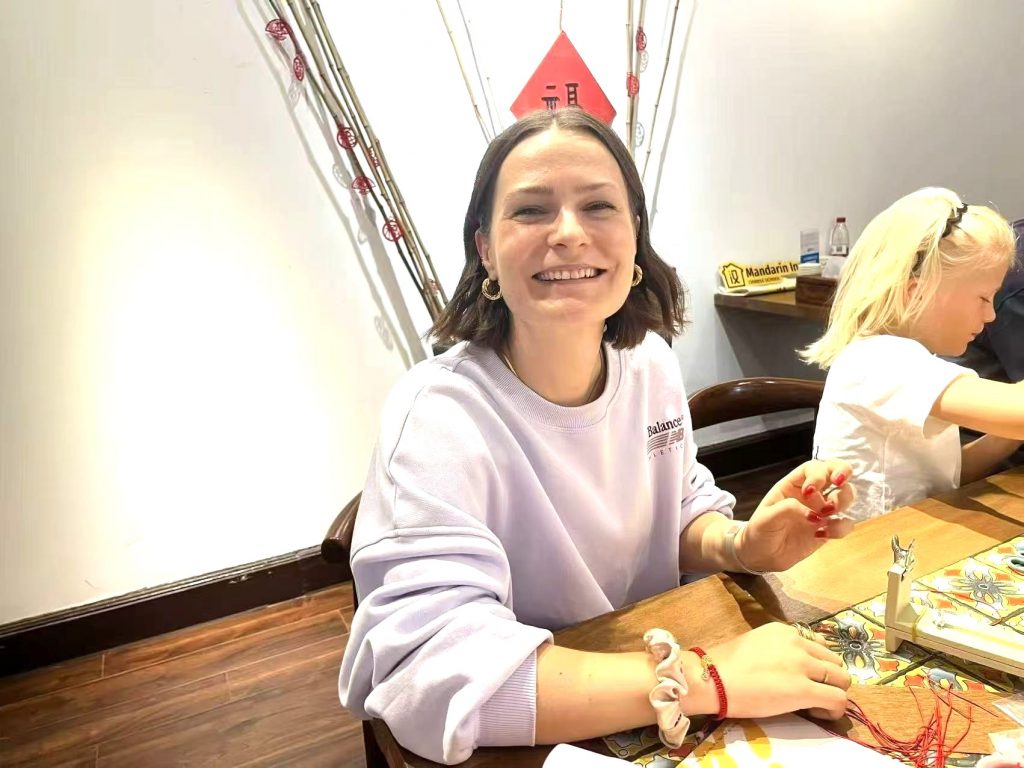
It’s fun to meet other students with a different goal than the usual setting of the classroom.
I don’t have any specific suggestions for now. More workshops or a shorter rotation of the classics would be great, so the next time doesn’t feel as long when I miss it.
A Lovely Story
Up until our move to Shanghai, I was so involved with work and daily life. There was not a lot of room for things I actually enjoy.

So now I get to invest in my hobbies again. This brings me a lot of joy and provides opportunities to practice Mandarin.
I enjoy cooking, playing music, hiking and cycling, to name a few.
Just today I had a lovely experience while cycling. Taking my bike to Changxingdao, I rode mostly by myself because it was a Tuesday morning. Suddenly a fellow Chinese cyclist passed me, looked back, and waited for me to catch up. He introduced himself, and we ended up chatting over the last 30km of our ride.
Mostly in English to be honest but he had fun speaking Mandarin and letting me figure out what it means.
Also, bonus point for him pushing me to probably cycle my personal best time (he was SO fit).
Favourite Chinese Sentence
My favourite Chinese sentence is: Wǒ de zhōngwén bù hǎo.
The very simple reason is that people often disagree when I say it. They compliment me on what I can actually say correctly, or compliment me on my pronunciation. It makes me feel like a 3-year-old kid learning a new skill and being proud of it.
In a busy and buzzing Shanghai, that is a little moment of connection and happiness.
Closing
Learning a language is perhaps not only about mastering a language, but about re-understanding the world.
If you would also like to build a deeper connection with Shanghai through Chinese, Mandarin Inn would be glad to keep a quiet desk for you.
In a century-old Shanghai villa, with people from around the world, learn slowly, speak slowly. (End)
Looking for the latest courses at Mandarin Inn?
Whether you prefer one-on-one tutoring or the dynamic of group classes, there’s a pace that fits you.
👉 Click here to explore our latest course offerings.
Join Mandarin Inn Chinese Courses and Cultural Workshops. From structured learning to real-life practice, we help you make Mandarin part of your everyday life.
Free trial is also available, click the link below to register!

Mandarin Inn, More Than Just a Language School
Located in the scenic heart of Shanghai’s former French Concession, Mandarin Inn is housed in a historic villa, offering not only an ideal place for studying Mandarin but also a chance to experience Shanghai’s rich history and culture. As the home of the APM Public Library and recognized by Ecovadis for corporate social responsibility, Mandarin Inn carries a dual mission of education and cultural heritage.